Retail maintenance: how ALE-HOP is scaling to 500 stores
Retail maintenance management: six lessons from ALE-HOP on going from 350 to 500 stores without losing control. Includes the video of the full talk.

Retail maintenance management: six lessons from ALE-HOP on going from 350 to 500 stores without losing control. Includes the video of the full talk.
It's time to break the reactive loop. Becoming a Strategic Facilities Manager shows you how.
 Learn more
Five years ago, ALE-HOP had around 200 stores. Today it has more than 350 across Spain, Portugal, Italy and Croatia, and it’s aiming for 500. Every opening adds assets, suppliers and issues, and a chain growing at that pace can’t leave its retail maintenance management to the memory of a handful of people.
At the Borrmart Group’s multi-sector event (the group behind the magazines Facility Management & Services, Limpiezas and Formación Seguridad Laboral), Manuel Vinaroz Gomis, Maintenance Manager at ALE-HOP, sat down with Asier Carrión, Senior Account Executive at Infraspeak, to explain how they’re doing it. They talked about what worked, what they had to tear down and what Manuel would do differently if he were starting today. The talk was in Spanish, so the quotes below are our translation.
Here are the main ideas from the talk, with a bit more context on ALE-HOP’s journey.
Everything changes scale. Every new store brings more assets, more suppliers, more issues and more people: at ALE-HOP, at least three or four more people per store. If the way of working isn’t ready, complexity grows faster than the team.
Before maintenance went digital, issues came in through a Google Drive form, an Excel sheet, the phone, WhatsApp or email. There was no traceability, photos and comments got lost along the way, and technicians went to each store “practically blind”, in Manuel’s words. Finding out which supplier had worked on a store before, or what an issue had really cost, took time nobody had.
None of these lessons depends on getting everything right from day one. They’re all about building a model you can repeat at every opening and correct as you go.
Today every ALE-HOP issue comes in through the same place, and anyone can see in seconds what’s happening in any store. Stores, technicians, suppliers and the maintenance team work from the same information, in real time.
The curious part is what happened to the number of issues:
“I raise more issues now than before. I’m not going to say fewer. What’s gone is the severity of the issue.”
With a single channel, stores report sooner and better, and problems get fixed while they’re still small. Air conditioning, the star issue in almost any maintenance operation, has dropped to fourth or fifth place at ALE-HOP. Furniture and its electrics now top the list.
ALE-HOP now manages more than 4,000 assets centrally. Even so, Manuel warns that the number isn’t the goal:
“If you register every asset, every light an asset, every fire extinguisher an asset, every speaker an asset, you’ll go mad.”
The first question is which asset is critical, and a criticality analysis saves a lot of back and forth. At ALE-HOP, the first level is the store. A QR code or an NFC tag gives access to its documentation and history, and lets you raise an issue without mapping every air-conditioning unit separately (if you’re starting out with this, here’s a guide to asset tagging).
The aim is for the history to live in the asset, not in someone’s head: what was done, which supplier stepped in and how much it cost. If someone on the team leaves tomorrow, whoever comes next finds everything there.
In year two, ALE-HOP realised it had set up its assets the wrong way. The fix was drastic: “We took the whole system down and rebuilt it the way we wanted.”
From there, they linked store staff and suppliers, assigned by area. Between the second and third year they already had a solid preventive plan and their statutory maintenance well documented. Every year they add something more to each store’s record, from whether it has ramps to photos of every intervention. For Manuel, the model has to stay alive: “Every year we take one more step towards where we want to get to.”
If he were starting today, there’s one mistake Manuel would definitely avoid: launching across all 200 stores at once. His alternative is “a smaller repeatable model, a smaller cluster of stores that can be replicated in others.”
ALE-HOP still applies that logic. New ideas are tested first in a pilot area, Andalusia, together with the suppliers, and once they work they’re rolled out to the rest. That’s how they reached Italy and Croatia without noticing the difference. And when a new person joined in Catalonia, within a week they were using the platform without a hitch.
Asier summed it up for the other chains in the room: ALE-HOP’s model doesn’t have to be yours, because every business is different, “but there has to be a model.”
ALE-HOP’s preventive maintenance is already planned up to 2028. That planning is what lets them anticipate instead of chasing every breakdown, the most direct way out of the reactive loop so many maintenance teams live in.
A three-year plan is only useful if it can be adjusted. As Manuel explained: “A regulation changes and we can change it in two clicks inside the platform.” If you want to build yours, this five-step preventive maintenance plan is a good starting point.
In the closing round of quick questions, Asier asked what he would do first if ALE-HOP hired him today to run all of maintenance. Manuel didn’t talk about software: he’d look for the right people.
“This is a job for people. We manage spaces, and I think what you manage is people.”
To get a team to adopt a new tool, his recipe has two parts. The first is believing in it yourself: “When you believe in it, the team believes in it.” The second is not running the project alone, but sharing it with someone at your level, because otherwise “you create a bottleneck.”
Technicians were told that the app is the same work as always, now on their phone, and that it saves them time. Every action is specified in detail (cleaning a filter, for example, means one photo before and one after), so anyone new works the same way from day one.
And the first thing Manuel checks every morning? He calls his technical team to see how they are, then compares open issues against closed ones.
Since centralising all its maintenance operations on Infraspeak, the collaborative FM platform, ALE-HOP:
manages more than 4,000 assets centrally
has increased issue resolution by more than 30%
saves more than an hour a day for every technician and manager, around 220 hours a year per person
has preventive maintenance planned up to 2028
As Manuel puts it: “Today we know exactly what’s happening in every store. We can anticipate. We’re not firefighting all day any more.”
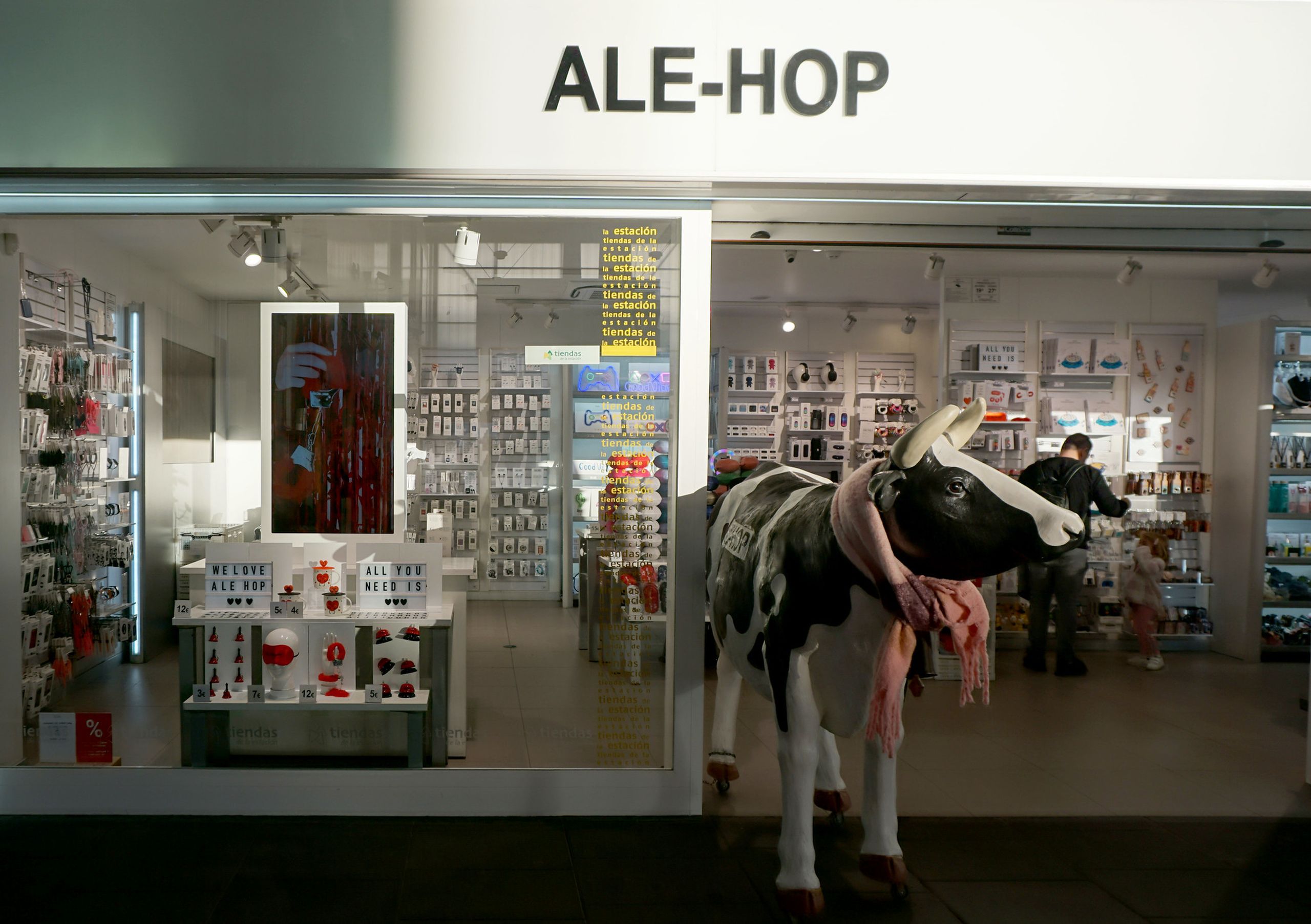
If you’ve ever walked into an ALE-HOP, you’ve met the cow at the door. The last question of the talk was whether it counts as an asset too. According to Manuel, it does: it’s the store’s most valued asset.
Scaling without losing control is possible if you have a model, test it small and dare to change it when it doesn’t work. Every chain will have its own, with its own stores, its own suppliers and its own cow.
Want to see what that model could look like across your stores? Book a demo with our team.

Infraspeak Platform
Capabilities
Industries
Resources


