The work that keeps the work from getting done
Reactive FM asks what failed. Strategic FM asks what's starting to fail more often, what's slipping, what will land on Friday at 4:47 p.m. if nobody intervenes first.

Reactive FM asks what failed. Strategic FM asks what's starting to fail more often, what's slipping, what will land on Friday at 4:47 p.m. if nobody intervenes first.

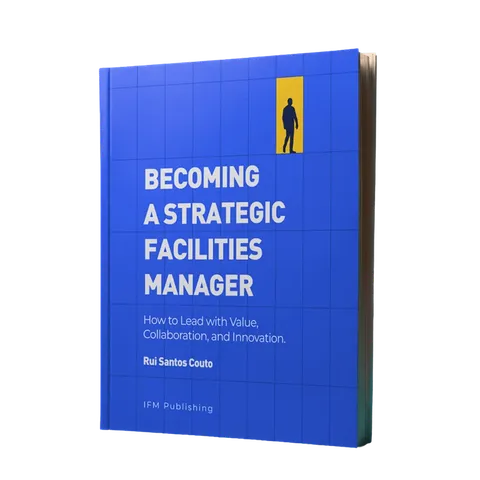
It's time to break the reactive loop. Becoming a Strategic Facilities Manager shows you how.
 Learn more
At 8:30 a.m., your inbox already has opinions.
A lift is stuck and two people have opened the same request because nobody knows whether the first one went anywhere. A compliance document is somewhere between "nearly ready" and "please don't ask."
By 10 a.m., the day has made your decisions for you.
Why is it hard to see from inside
A team that reacts fast looks productive. A manager who jumps on every escalation looks committed. A technician who patches the same fault for the third time this month looks helpful.
People are working hard. The system keeps asking them to do the wrong kind of work — and from the outside, it's almost impossible to tell the difference.
The loop starts with nothing dramatic. A missed work order, a provider who's late, a handoff that drops context. Time goes into reconstruction: what happened, when, according to whose version. Before the first issue closes, another lands. Planned work slips. Reports get postponed. The work that might have broken the pattern gets pushed again.
The cost nobody budgets for
Leadership notices FM when something breaks. They see the burst pipe, not the inspection programme that prevented ten others. FM becomes visible at the worst moment, which means budget conversations happen on the back foot — defended with anecdotes because the evidence is scattered across too many systems.
Sustainability targets wait. Lifecycle planning gets pushed back. Supplier performance gets reviewed after the disappointment. User experience becomes a clean-up job.
Reactivity keeps FM busy enough to earn respect for effort, but too busy to prove its value.
More effort won't fix it
Working longer, replying faster, and building one more tracker gets you through the week, but won't change the conditions.
Start with where context gets lost. A useful test: if one key person is off sick, can the operation still tell you what happened yesterday?
Then cut the admin that masquerades as management. A manager copying the same update into three systems isn't managing FM. They're acting as human middleware, which is funny for about five seconds.
Then look ahead. Reactive FM asks what failed. Strategic FM asks what's starting to fail more often, what's slipping, what will land on Friday at 4:47 p.m. if nobody intervenes first. The clues are already in your data — work orders, asset history, energy bills, supplier records. Patterns live in boring places.
The Schiphol fly
Cleaning costs at Schiphol's men's toilets were too high. The standard responses were on the table: more cleaning, better signage, reminders. Instead, Jos van Bedaf asked why men were missing in the first place. He etched a small fly near the drain. Problem solved.
The question that produced the fly is the point.
A manager inside the reactive cycle rarely gets to ask that kind of question. They're too busy dispatching the cleaner and explaining the monthly cost variance.
Name it before it becomes the culture
Say "we're in the reactive cycle," and the conversation changes. You stop hunting for the guilty party. You start looking at how work enters the system, where it stalls, why the same issues keep returning.
Once the pattern is visible, it gets harder to defend as normal.
This article draws on Becoming a Strategic Facilities Manager, by Rui Santos Couto. The book goes deeper into the FM Reactive Loop, the FM Iceberg, data, collaboration, sustainability and the move FM now has to make: survival is not a strategy. Grab your copy.


)
)
)