FM report 2027: find your gaps before an auditor does
More and more of the pressure on FM comes from outside the team. In 2027, more people will be asking FM questions it needs to answer quickly.

More and more of the pressure on FM comes from outside the team. In 2027, more people will be asking FM questions it needs to answer quickly.

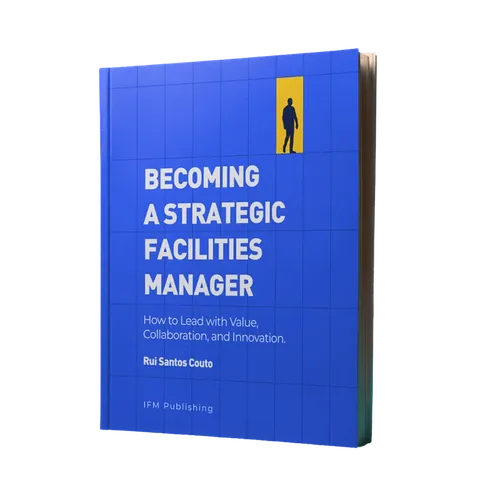
It's time to break the reactive loop. Becoming a Strategic Facilities Manager shows you how.
 Learn more
Sooner or later, someone outside the FM team asks a question the team can't answer quickly. A client wants proof the work was done. The board wants to know what FM costs per site. An auditor wants a certificate that should be in the shared drive, somewhere.
Those questions are becoming more common, and they're the reason we created our FM report, The State of FM Operations 2027: The FM Gaps. It's there to help FM leaders see how their operation compares, find its weak spots and get ready before someone else points them out.
It's a picture of how FM teams really run their operations: the tools they rely on, what slows them down, who they work with and what's pushing them to change. It's built from a year of conversations between Infraspeak, the collaborative FM platform, and 1,071 FM teams, mostly in Europe and Latin America.
That's what sets it apart. A survey asks people to tick boxes about their operation. A conversation lets them describe it: the job sheet that gets typed up twice, the one technician who always picks up the phone, the management report that takes two days to build. The report is made of those descriptions.
Because FM doesn't have a shared picture of how operations run day to day. Most FM leaders judge their operation in isolation. They know what's going wrong in their own buildings, but not whether it's normal, unusual or about to get worse. Without that benchmark, it's hard to know where to start, and harder to make the case to leadership.
We happen to hear that picture more than most. Every week, we talk to FM teams across Europe and Latin America about how they run their operations, what slows them down and what they'd change. Those conversations usually stay inside sales and customer calls. This report brings them together, so FM leaders can use what we hear to measure their own operations.
It also picks up where our 2026 survey of 281 FM professionals left off. That survey asked where FM is heading. This report looks at how FM runs today.
Three things: understand where FM stands, assess your own operation and prepare for what's coming.
The report gives FM a common language for what's going wrong. Across a year of conversations, the same problems kept coming up, and the report groups them into the FM gaps:
The admin gap: the manual work that eats the time meant for prevention, planning and people.
The connection gap: the breakdowns between in-house teams, contractors, suppliers and clients who work on the same buildings but not on the same system.
The visibility gap: the risks and results nobody can see or measure, the part of the FM Iceberg that only surfaces when something breaks.
A team that can say "our problem is the handoffs with contractors" can start fixing it. "Everything's a bit chaotic" is much harder to act on. And for context on the starting point: more than half of the teams we spoke to still run their operation on Excel.
A benchmark is only useful if you can hold your own operation up against it, and the report is written so you can do that gap by gap. For a head start, try these three questions:
Does anyone on your team retype work that was already written down somewhere else?
If you changed supplier tomorrow, would your asset history stay with you?
If leadership asked for your SLA compliance right now, could you give them a number?
Every "not really" points to a gap worth closing. If the last one stung, this guide to facilities management reports is a good place to start.
More and more of the pressure on FM comes from outside the team. Clients and tenders ask for proof of work. Growth turns "we'll manage with Excel" into "we can't see what's going on". A change of supplier can take the maintenance history with it. In 2027, more people will be asking FM questions it needs to answer quickly.
The report also points to where to start. It closes with five practical moves for 2027, from capturing work once at the source to automating the admin while keeping the decisions with people.
Start with the gap that hurts most. Read how other teams describe the same problem and where they're starting.
Hold it up against your own operation. Use the gaps as a checklist with your team, and be honest about where you land.
Take it to leadership. The five moves give you somewhere to start, and the report gives you the context to explain why.
The questions are coming either way. The FM report 2027 helps you have the answers ready, before an auditor, a client or a broken chiller asks for them.
The State of FM Operations 2027: The FM Gaps is Infraspeak's report on how FM teams run their operations. It's built from a year of conversations with 1,071 FM teams, mostly in Europe and Latin America.
FM leaders, both in teams that run their own buildings and in FM service providers, who want to see how their operation compares and where to start improving it.
The 2026 report was a survey of FM professionals about where FM is heading. The 2027 report is built from conversations with FM teams and looks at how their operations run today.

Infraspeak Platform
Capabilities
Industries
Resources


