Reactive maintenance in small teams: when requests swamp the week
Why reactive maintenance in small teams gets out of control, where the workflow breaks down and how to choose a system that reduces it.

Why reactive maintenance in small teams gets out of control, where the workflow breaks down and how to choose a system that reduces it.
It's time to break the reactive loop. Becoming a Strategic Facilities Manager shows you how.
 Learn more
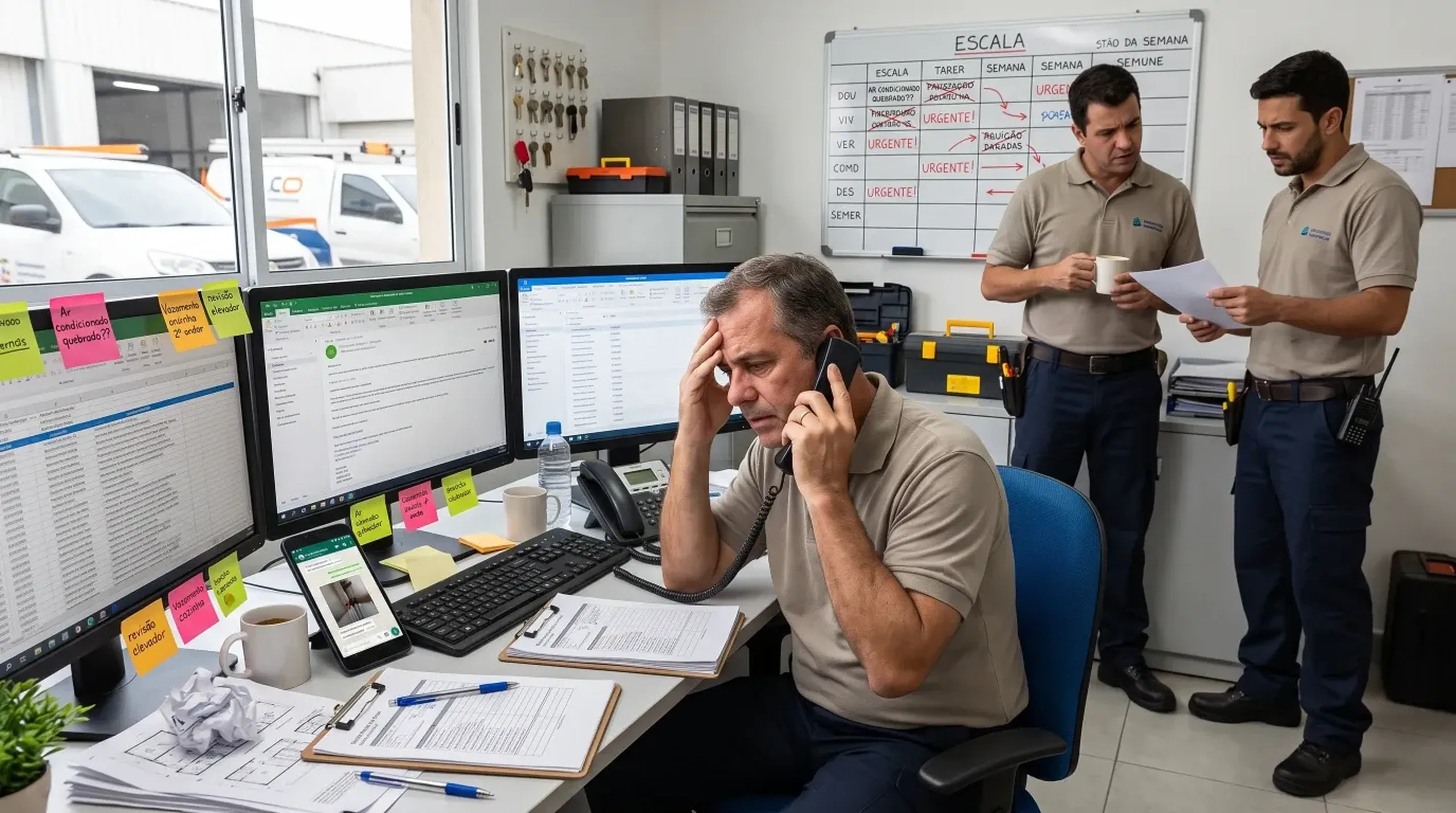
There's a Post-it on your monitor that just says "AC broken??". The leak in the second-floor kitchen has been reported twice over the weekend, once by email and once as a WhatsApp photo, and your three technicians haven't finished their first coffee. Their week is already planned for them.
That's reactive maintenance in small teams: everyone works flat out, the requests keep coming, and by Friday the preventive jobs you scheduled have slid into next week's column (again). Your team is working harder than ever, so why isn't the operation getting better? The answer usually sits in how you handle reactive maintenance, or don't.
This guide covers what reactive maintenance is, why corrective maintenance requests get out of control in small teams, the workflow bottlenecks behind it and what to look for in a better system.
Reactive maintenance is any work triggered by a failure or a report instead of a plan. A tap leaks, a lift stops between floors, a tenant says the meeting room is 29°C, and someone has to go and sort it.
Corrective maintenance is the work that brings an asset back to normal once a fault has been found. The two terms often get used interchangeably and they overlap a lot, with one useful difference: corrective work can also be planned. If a technician spots a worn belt during a routine inspection and books the replacement for Thursday, that's corrective maintenance without the emergency. Our guide to the main types of maintenance covers the full family.
Managing reactive maintenance covers everything that happens around that unplanned work: how requests come in, how they're prioritised, who gets assigned, how progress is tracked, how jobs are closed and what you learn from them afterwards. Maintenance request management, the intake and triage end of it, is usually where small teams feel the pain first.
Some reactive work is a sensible choice. Letting a desk lamp run to failure makes more sense than putting it on a PPM plan. The trouble starts when reactive work stops being a choice and becomes the way the whole operation runs.
Because in a small team, the people who take the requests are the same people who fix them. Large teams have a help desk, a planner and a supervisor on every shift. Small maintenance teams have three or four people doing everything: taking the call, judging how urgent it is, doing the repair, chasing the supplier and writing it up. The FM manager is usually the help desk, the planner and the escalation route, all from one phone.
That works until the volume grows faster than the team, which is what's happening across FM. In the research behind Infraspeak's book Becoming a Strategic Facilities Manager, 42.6% of FM teams said they're already undersized and 55.7% expect their volume of work to grow.
With no slack in the week, every urgent request takes time from something planned. Preventive jobs slip, so more assets fail, so more urgent requests arrive and the team has even less time for prevention. We call this the FM Reactive Loop. Nobody designs it on purpose, but the workflow builds it anyway, one skipped PPM at a time. That's why firefighting is a system failure, and why working harder doesn't fix it.
The loop runs through the same weak points in most maintenance operations: how requests come in, how they're prioritised, how information moves, how status is tracked and what happens once a job is closed. Here's where requests usually get stuck:
Requests arrive through every door. Email, phone, WhatsApp, the corridor ("while you're here, could you have a look at…") and the odd Post-it. With no single way in, the same fault gets reported three times and a different one never gets logged. Nobody can say how many requests are open, so nobody can plan around them.
Priority goes to whoever shouts loudest. Without agreed criteria, the director's flickering office light jumps ahead of the air handling unit that's started making a new noise. Triage becomes a rushed judgement call, made by whoever picked up the phone.
Information gets lost at the handoffs. The technician turns up without the photo, the asset's history or the right part, and has to come back tomorrow. When a supplier is involved, the details travel by phone call and memory. Every handoff is a chance for the job to stall, which is why communication in facilities management matters more than most teams give it credit for.
Status lives in people's heads. "What's the status?" "Just checking in." "Who's handling this?" When the only way to know where a job stands is to ask someone, the FM manager turns into a human switchboard and spends the day answering questions instead of making decisions.
Closed jobs teach you nothing. The job gets closed and the lesson goes with it. The same toilet in the same block gets fixed for the sixth time this quarter, but nobody spots the pattern because the history is spread across five inboxes and a spreadsheet nobody's touched since the last audit.
Each bottleneck on its own is an annoyance. Together, they keep a capable team in survival mode.
Because speed doesn't change the balance between reactive and preventive work. The obvious fix is to get through the requests faster: one more technician, tighter response times, a Saturday spent clearing the backlog. It helps for a few weeks, then the loop catches up.
Meanwhile, the cost builds up where it's hard to see:
Preventive programmes slip, which raises your compliance exposure and makes the next failure more likely.
An avoidable failure becomes a serious incident, and the warning signs were sitting in the request log all along.
Your best people burn out and leave for organisations with better tools and calmer weeks.
In-house teams get funded as a cost centre, because a function that only fights fires is all leadership ever sees.
Service providers deliver uneven service, and clients start looking for someone who can show proactive delivery.
Judge a system by one thing first: will it shrink the share of reactive work in your operation over time? Plenty of maintenance software promises to help you close tickets faster. That's useful, but it's the wrong test.
Breaking the Reactive Loop takes four moves at once: connect the chain, cut admin through automation, use data to anticipate, and align teams and suppliers around shared priorities.
If you're rethinking the whole flow from request to close-out, our guide to work order management breaks it into phases. When you're comparing systems, use these criteria:
One front door for requests. Can anyone report an issue in a few seconds (a tenant, a receptionist, a security guard) without an account or training? Does the request arrive with the location, the asset and a photo already attached?
Priorities based on impact. Can you set priorities and SLAs by asset criticality and location, so requests are ranked before anyone has to argue about them?
Admin that runs itself. How much of the routing, assignment, notifications and follow-ups happens automatically? Count the clicks between a new request and an assigned technician.
Shared visibility at every handoff. Can technicians, suppliers and requesters all work on the same job, with its history, photos and messages in one place? Can a requester check progress without calling you?
Built for the field. Can technicians receive, update and close jobs on their phone, including in a plant room with no signal?
Patterns you can act on. Does the system show recurring failures by asset, your reactive-to-preventive ratio and what reactive work is costing you, in a format you could put in front of leadership or a client?
Realistic for a small team. Can you set it up and run it without a full-time admin? Small maintenance teams don't have spare hours to babysit a new tool.
Then ask the vendor one last question: in six months, what share of our work will be reactive? If the answer is only about response times, keep looking.
That's the problem Infraspeak, the collaborative FM platform, was built around. Requests, teams, suppliers and assets sit in one platform. The Infraspeak Direct Page lets anyone report an issue by scanning a QR code, with no login. Gear AI Automations takes the repetitive admin off your plate, from work orders to supplier management, and saves up to 8 hours per week. Infraspeak Network puts your suppliers on the same work orders as your team, and Infraspeak Mobile keeps technicians working in that signal-free plant room until everything syncs.
Reactive work will never hit zero, and it shouldn't. A pipe will still burst on the coldest night of the year. The goal is an operation where reactive work is handled with control and gets smaller every quarter, instead of eating everything else.
Our post on breaking the FM reactive loop goes deeper into how that shift works in practice.
Already know where your loop starts? Book a demo and we'll show you how Infraspeak helps your reactive work get smaller every quarter, starting with a week that looks like yours (Post-it on the monitor included).


